
Searching Kane County Civil Dockets
Utah Courts XChange is the public search tool for District and Justice Court case history. Pick the court jurisdiction first. Set the county to Kane, then enter a party name, a company name, or a case number. District Court carries most general civil, domestic, property, and probate matters. Justice courts handle small claims within their local authority.
Broad name searches cost money and return noise. Narrow the field with the civil case type, the court, and a filing date range. XChange caps results at 500. Even with a case number in hand, pair it with its court. Utah warns that numbers are not unique statewide.
- Select District Court or the applicable Justice Court.
- Choose Kane County or the exact local court.
- Enter a party name, company, or case number.
- Confirm the case type and filing date.
- Open the history, then request needed records from the clerk.
Kane County Civil Search Fields
The official XChange help screen displays the filter set: name, court, case type, birth date, and date range.
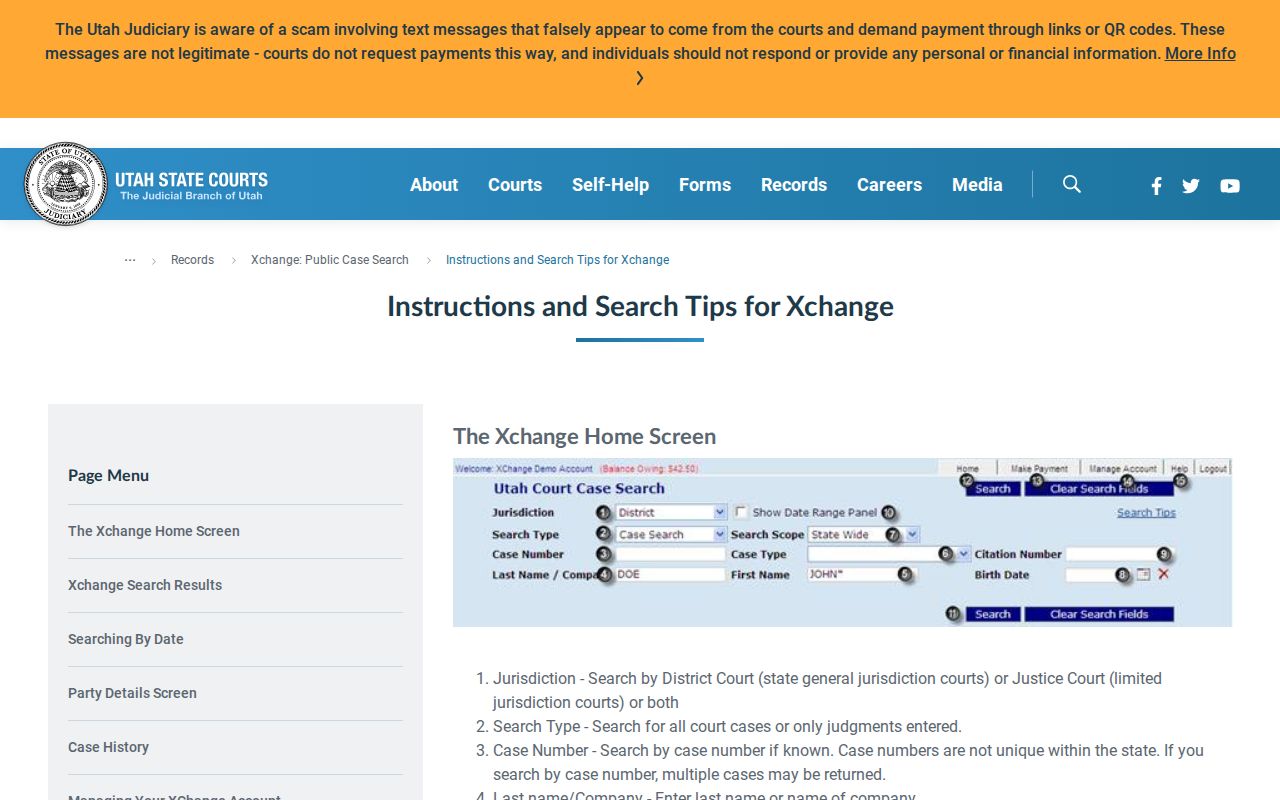
| Search field | Civil use | Practical note |
|---|---|---|
| Last name or company | Find a listed party | Add court and dates to narrow matches |
| First name | Refine an individual search | Official tips allow a wildcard |
| Case type | Separate contract, probate, domestic, or other classes | Select the closest official code |
| Case number | Reach a known case | Pair it with court location |
| Date range | Find filings, dispositions, or judgments | Choose the right event date |
Each result can show the court, case type, case number, filing date, parties, role codes, and a link into the case history. Verify those fields before paying for any document.
Inside a Kane County Civil Docket
A case history is a procedural record, not a story of the dispute. Expect to see the parties and their lawyers, the assigned judge, filings, hearings, judgments, orders, and events. These appear in the order they occurred. Party roles matter here. Plaintiff, defendant, petitioner, respondent, and interested person each carry a distinct meaning.
| Court and location | The District or Justice Court where the action is filed. |
|---|---|
| Case number and type | The identifier and official subject code, read together. |
| Parties and codes | Named participants and procedural roles, subject to privacy rules. |
| Judge and attorneys | Assigned judicial officer and counsel entered in the record. |
| Documents | Public filings that may be available for separate purchase. |
| Proceedings | Hearings, motions, orders, judgments, and later case events. |
Seeing the public history does not guarantee that every pleading or attachment is open. Exhibits marked sensitive, medical material, financial data, and records involving children may be private or redacted.
Kane County Small Claims Routing
Utah routes small claims to its Justice Courts. Kane County Justice Court takes small claims for unincorporated Kane, Kanab, and Alton. State guidance maps Glendale to Orderville Municipal Justice Court, which also handles its own municipal matters.
Location controls. A Kane County address does not always point to Kane County Justice Court. Identify the city or town court before filing, searching, or requesting a copy.
In XChange, code SC means small claims. Code ST flags a small-claims trial de novo, a fresh trial that follows the justice-court path. The docket may list parties, hearings, a judgment, and later satisfaction or disposition, without letting you download every filed paper.
Civil Case Types on the Docket
Sixth District Court hears more than one kind of civil dispute. XChange assigns a code to each category, and checking that code keeps unrelated cases from getting mixed up.
- Contracts, debt collection, and hospital or tax liens.
- Property rights, foreclosure, condemnation, and interpleader.
- Tort, civil rights, and other general civil actions.
- Domestic relations, custody, paternity, and protective orders.
- Estate, trust, guardianship, conservatorship, and other probate cases.
- Small claims in the applicable Justice Court.
Code EV means eviction. Contracts carry CN, divorce or annulment carries DA, and ES points to an estate or personal representative. These labels sort cases into court categories; they say nothing about the merits or the full contents of any file.
Kane County Domestic Record Limits
Utah treats several family and domestic categories as private or partly private. Divorce, separate maintenance, custody and support, paternity, cohabitant abuse, civil stalking, and related proceedings are the examples. Public case history, minute entries, judgments, orders, and decrees can still be accessible. A rule or a court order can close them.
A visible case name does not open every filing. The question to ask is whether the specific docket entry or document is public. Never repeat a child's name, an address, financial facts, or protected-party details pulled from a file. A party seeking their own eligible record can use MyCase. They can also ask the clerk about identity-based access.
Kane County Probate Dockets
Probate codes span estates, trusts, conservatorships, adult or minor guardianships, supervised administration, and minor settlements. A case history might show an appointment, an order, a judgment, or a hearing. An inventory, medical record, or minor-related paper stays restricted.
An interested person can search public history in XChange. Then ask the District Court clerk for an available record. Access turns on party status and the classification of the specific document. The case type alone promises nothing about the whole file. When the needed item is nonpublic, the record request must state the requester's basis. It must also carry any needed authorization through a private channel.
Civil Docket Settings and Hearings
A civil docket can hold motion hearings, scheduling events, trials, judgment entries, and later enforcement or satisfaction proceedings. The filing date only marks when a paper entered the court system; it is not the next hearing date. Utah calendars cover a two-week window and refresh daily. The legacy Kanab schedule link for Kane does not serve a usable current table, so rely on XChange and direct clerk confirmation for a specific case.
A continuance moves an event. A reset changes the setting. Neither one dismisses the case. For the full local calendar path, see Kane County Court Dates.
Kane County Civil Filing Access
Utah Courts eFiling is the filing system for authorized attorneys and filers.
Self-represented parties who qualify can use MyCase and MyCourtCase features for their own case history, hearings, documents, payments, notices, and selected filing. An account and identity verification are required. Nobody can use it to search another person's name. Public case history stays in XChange, and formal filing goes through the authorized channel.
Kane County Civil Access Channels
Online XChange charges fees. But you can inspect records for free on public terminals at most district courthouses and a few justice court locations. Not every justice site has one, so phone first. Free XChange access is also available at the Utah State Law Library. Printing there runs 20 cents a page.
For district civil, domestic, and probate records, contact the District Court clerk at 76 N Main Street, Suite 2, Kanab. Or call 435-264-4790 or 435-264-4791. Small claims belong to the Kane County Justice Court at the same street address, reachable at 435-644-2351. Orderville's clerk takes calls at 435-648-2534. A clear written request may go through mail, email, fax, pickup, or an in-person look at the court docket. County administrative hours are not the same as court-counter hours. So confirm before you drive over.
Civil Docket Access Rules
Utah court records are open to anyone. That is the default. But a record marked private, protected, sealed, or otherwise restricted needs a lawful basis before you can see it. Access is decided piece by piece, so a single Kane County civil docket can hold a public entry next to a private document.
Key Utah rules:
UCJA Rule 4-202.02 defines public and nonpublic court-record classes.
UCJA Rule 4-202.03 governs public access and access to sealed or special records.
UCJA Rule 4-202.04 requires a written request that reasonably identifies the record.
The clerk has real choices here. A court record may be redacted, a request denied, or the question passed to a judge to decide. Utah GRAMA covers many county administrative records, but the judiciary's own rules govern court records instead.
Kane County Civil Copy Costs
XChange pricing is simple. A one-time transaction is $10 and covers up to 10 searches, with each available document billed separately at $1. Subscriptions cost $25 to set up plus $40 per month for up to 500 searches, and every search past that limit is $0.35.
| Clerk service | Published fee | Note |
|---|---|---|
| Paper copy | $0.25 per sheet | For clerk-provided pages |
| Email or fax | $5 through 10 pages | $0.50 per extra page |
| Staff time | First 15 minutes free | Then applicable employee rate |
| Actual cost | Added when delivery is mailed | |
| Certification | Applicable certification fee | Only for an accessible identified record |
Request an estimate for anything large. The same goes for requests needing staff research. Utah sets a general expectation that court-record responses arrive within 10 business days, though retrieval, access review, payment, and the request's complexity can all stretch that window.